• About Tuzla

    Tuzla city is situated in north - east part of Bosnia and Herzegovina, it's administrative center of Tuzla Canton, and economic, scientific, cultural, educational, health and tourist centre of northeast Bosnia.

  • University of Tuzla

    University of Tuzla (est. 1976) is public university located in Tuzla. It's the most important and major educational and scientific institution in northeast Bosnia.

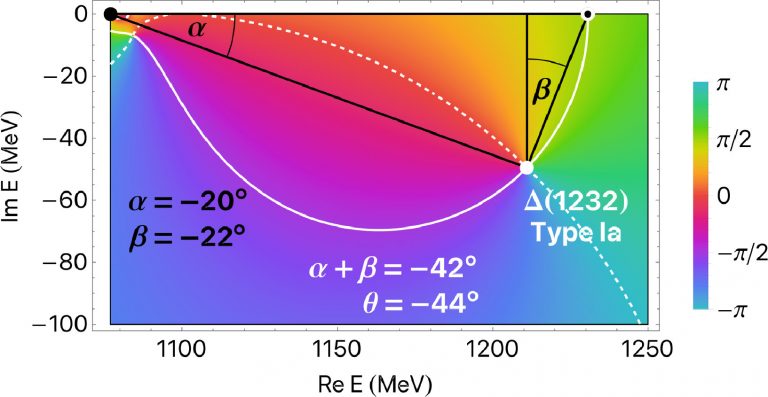
Time-Reversal Symmetry and Geometric Constraints on the Residue Phase of Pion Photoproduction via Δ(1232)

Ceci, S.; Omerović, R.; Osmanović, H.; Uroić, M.; Vukšić, M.; Zauner, B. Time-Reversal Symmetry and Geometric Constraints on the Residue Phase of Pion Photoproduction via Δ(1232). 
Symmetry 2026, 18, 1184. 

The electromagnetic coupling phase at the complex resonance pole is a fundamental property of nucleon excitations. However, its extraction from pion photoproduction data remains model-dependent, particularly for the 𝛥(1232)  resonance, where modern multichannel analyses report helicity amplitude phases ranging from +3 to −18°. In this Letter, we present a largely model-independent geometric S-matrix formalism that provides a physical constraint for this ambiguity. By imposing Watson’s final-state interaction theorem, a direct consequence of S-matrix unitarity and time-reversal symmetry, on the real energy axis and performing an analytic continuation, we isolate the kinematic threshold barriers of the photoproduction (𝑘·𝑞) and elastic (𝑞3) amplitudes. For the dominant 𝑀1+ multipole transition of the 𝛥(1232), our method yields a kinematically constrained prediction of 𝜙𝐸𝑀=−8.5°+0.6°−1.0° for the electromagnetic residue phase. This geometric constraint explains the numerical results of coupled-channel phenomenological fits, validating the extractions by the SAID and Bonn–Gatchina groups, and establishes a theoretical benchmark for evaluating resonance properties.


Share:

Geometric Constraint on Residue Phases: Resolving the N (2190) Anomaly and Implications for Exotic States

S. Ceci, R. Omerović, H. Osmanović, M. Uroić, M. Vukšić, B. Zauner, Geometric constraint on residue phases: resolving the N(2190) anomaly and implications for exotic states, Physics Letters B, Volume 875, 2026, 140332, ISSN 0370-2693, https://doi.org/10.1016/j.physletb.2026.140332.

(https://www.sciencedirect.com/science/article/pii/S0370269326001863)

Abstract: We derive a parameter-free geometric constraint on residue phases dictated by the pole-threshold angle. Using the N(2190) anomaly as a test case, this constraint reveals a sign ambiguity in prior data; correcting the sign ambiguity yields a phase of −28∘±10∘, matching our prediction. This consistency validates the method as a model-independent diagnostic for distinguishing compact from molecular states, offering a rigorous tool for exotic spectroscopy.

Keywords: Unitary S-matrix; Baryon and meson resonances; Resonant properties


Share:

No hidden physics in resonance pole residue phase

New publication: 

S. Ceci, R. Omerović, H. Osmanović, M. Uroić, B. Zauner, No hidden physics in resonance pole residue phase, Physics Letters B, 2025, 140136, ISSN 0370-2693,
https://doi.org/10.1016/j.physletb.2025.140136
(https://www.sciencedirect.com/science/article/pii/S0370269325008925)

 
Abstract: In hadron resonant scattering, there are four fundamental resonant parameters: real and imaginary parts of the pole position, and the magnitude and the phase of the residue. Out of the four, the last one is the least understood. The search for the residue phase’s physical meaning has focused on model-independent phases of the majority of the lowest-mass resonances. Here, we apply a simple mathematical identity to the amplitude in the complex plane to reveal the exact reason for the noticed regularity and show that there is no room for hidden physical variables in the residue phase.
Keywords: Resonant scattering; Unitary S-matrix; Resonant properties; Baryon and meson resonances


Share:

ANU BiH: Susreti mladih istraživača BiH iz STEM oblasti

 Susreti mladih istraživača Bosne i Hercegovine iz oblasti prirodnih, tehničkih i matematičkih nauka (STEM) održani su 3. i 4. novembra 2023. godine u organizaciji Odjeljenja tehničkih nauka Akademije nauka i umjetnosti Bosne i Hercegovine i u saradnji s Federalnim ministarstvom obrazovanja i nauke.

Jedan od glavnih ciljeva ovog skupa bio je uspostavljanje kontakata s mladim istraživačima porijeklom iz Bosne i Hercegovine koji djeluju u STEM oblastima na univerzitetima i istraživačkim institucijama u svijetu.

Skup je prvenstveno bio namijenjen studentima doktorskih studija u STEM oblastima i mladim istraživačima koji su doktorirali u posljednjih pet godina, ali i svim zainteresiranim istraživačima, članovima akademske i naučne zajednice u Bosni i Hercegovini te predstavnicima bh. privrede.

Skup se sastojao iz tri dijela: dva pozivna predavanja koja su održali gospodin Namik Hrle, inostrani član ANUBiH, IBM Fellow, direktor IBM-ovih globalnih razvojnih timova iz područja baza podataka i umjetne inteligencije i direktor IBM-ove najveće razvojne laboratorije u Njemačkoj i Suad Krilašević, doktorand na Tehničkom univerzitetu u Delftu i predsjednik Asocijacije za napredak nauke i tehnologije u Bosni i Hercegovini.

U drugom dijelu skupa predstavljeno je 28 prezentacija istraživanja studenata III ciklusa i mladih istraživača koji su doktorirali u proteklih 5 godina. Naučni odbor skupa dodijelio novčane nagrade za najbolje prezentacije istraživanja.

Detaljnije na LINKU!


Share:

KLF Collaboration

At the first stage the KLF (K Long Facility) program will focus on two-body and quasi-two-body reactions: elastic $K_L p → KS_p$ and charge-exchange $K_L p → K^+ n$ reactions, then on two-body reactions producing $S = −1$ ($S = −2$) hyperons as $K_L p → π + \Lambda$, $K_L p → \pi+Σ^0$ , and $K_L p → π^0 \Sigma^+ (K_L p → K+Ξ 0 )$, as well as three body $K_L p → K^+ K^+ \Omega^ −$.

A coupled channel PWA of the KLF data can be performed standalone and in conjunction with an analysis of the data from the J-PARC K−p measurements, if available. The best fit will determine the partial wave amplitudes and the resonance pole positions, residues and Breit-Wigner (BW) parameters. These will provide a benchmark for results of forthcoming Lattice QCD calculations and elucidate the structure of the strange hyperons.

PWA Tuzla Group is a part of the KLF Collaboration.


Share:

STRONG 2020 Workshop


STRONG 2020 (14-16 September - University of York) is included in the activities of the working package WP25 (Light-and heavy-quark hadron spectroscopy) of the project STRONG-2020. It has received funding from the European Union’s Horizon 2020 research and innovation programme under grant agreement No 824093.

POSTER: SE  PWA for pion photoproduction with vfixed-t analyticity

The major topics of the workshop will cover:

1) Precision calculations in non-perturbative QCD: Effective Field Theories, analyticity, dispersion relations and Lattice QCD

2) Spectroscopy & Exotic states

3) Hadron Decays & Production

4) Form factors, LECs, fundamental parameters of QCD and light nuclei
spectroscopy

Share:

Single-energy partial-wave analysis for pion photoproduction with fixed-t analyticity

Received 15 July 2021

Accepted 20 August 2021

DOI:https://doi.org/10.1103/PhysRevC.104.034605

©2021 American Physical Society

Abstract

Experimental data for pion photoproduction including differential cross sections and various polarization observables from four reaction channels, $\gamma p \rightarrow \pi^0 p$, $\gamma p \rightarrow \pi^+ n$, $\gamma n \rightarrow \pi^− p$, and $\gamma n \rightarrow \pi^0  n$, from threshold up to W= 2.2 GeV were used in order to perform a single-energy partial-wave analysis with minimal model dependence by imposing constraints from unitarity and fixed-t analyticity in an iterative procedure. Reaction models were only used as a starting point in the very first iteration. We demonstrate that with this procedure partial-wave amplitudes can be obtained which show only a minimal dependence on the initial model assumptions. The analysis was obtained in full isospin, and the Watson theorem is enforced for energies below W= 1.3 GeV but is even fulfilled up to W≈ 1.6 GeV in many partial waves. Electromagnetic multipoles $E_{ℓ\pm}$ and $M _{ℓ\pm}$ are presented and discussed for S, P, D, and F waves.


Share:

Single-energy partial wave analysis for π0 photoproduction on the proton with fixed-t analyticity imposed

  • Received 16 August 2019

DOI:https://doi.org/10.1103/PhysRevC.100.055203

©2019 American Physical Society


Abstract 

High-precision data of the $\gamma p \rightarrow \pi^0p$ reaction from its threshold up to W=1.9GeV have been used in order to perform a single-energy partial-wave analysis with minimal model dependence. Continuity in energy was achieved by imposing constraints from fixed-t analyticity in an iterative procedure. Reaction models were only used as starting point in the very first iteration. We demonstrate that, with this procedure, partial-wave amplitudes can be obtained which show only a minimal dependence on the initial model assumptions.


Share:

SFB-S3 Collaboration meeting - Mainz 2019 Program


SFB-S3 Collaboration meeting
Partial Wave Analysis with Analytical Constraints
Mainz, 18-21 February 2019

Talks can be downloaded from our GitHub Page

Monday, 18 February, 10:00-12:00, A2 meeting room, Neubau, 1OG, 01-122

Jugoslav Stahov/Hedim Osmanovic: Preliminary results on single-energy PWA for $\gamma,\pi$
Rifat Omerovic:  Data binning for PWA of pion photoproduction

Monday, 18 February, 14:00-17:00, A2 meeting room, Neubau, 1OG
Discussions

Tuesday, 19 February, 10:00-12:00, KPH Seminar Room, Foyer

Michael Ostrick: Opening
Andrey Sarantsev: Eta Photoproduction in the Bonn-Gatchina model
Deborah Rönchen: Eta Photoproduction in the Jülich-Bonn model

Tuesday, 19 February, 14:00-17:00, KPH, Seminar Room


R.Beck, F.Afzal : New experimental results from ELSA and MAMI
Lothar Tiator: Eta Photoproduction in the MAID model
Alfred Svarc: Phase Ambiguities in Eta Photoproduction
Discussions

Tuesday, 19 February, 17:30 dinner in "Plaka"

Wednesday, 20 February, 10:00-12:00, A2 meeting room, Neubau, 1OG, 01-122

Kirill Nikonov: Dispersion Relations for Eta Photoproduction
Misha Gorchtein: Behaviour of Regge background under DR
Victor Kashevarov: Results on DR for high energies and proton and neutron

Wednesday, 20 February, 14:00-17:00, A2 meeting room, Neubau, 1OG
Discussions

Thursday, 21 February, 10:00-12:00, A2 meeting room, Neubau, 1OG, 01-122
Discussions
Share:

Eta and etaprime photoproduction on the nucleon with the isobar model EtaMAID2018

L. Tiator, M. Gorchtein, V. L. Kashevarov, K. Nikonov, M. Ostrick, M. Hadžimehmedović, R. Omerović, H. Osmanović, J. Stahov, A. Švarc
The European Physical Journal A

Received 13 July 2018,  Accepted 20 October 2018.  First Online 06 December 2018
DOI https://doi.org/10.1140/epja/i2018-12643-x 
Publisher Name Springer Berlin Heidelberg
Print ISSN 1434-6001 Online ISSN 1434-601X

The isobar model EtaMAID has been updated with new and high precision data for 𝜂 and 𝜂′ photoproduction on protons and neutrons from MAMI, ELSA, GRAAL and CLAS. The background is described in a recently developed Regge cut model, and for the resonance part the whole list of nucleon resonances has been investigated with 21 𝑁∗ states contributing to 𝜂 photoproduction and 12 𝑁∗ states contributing to 𝜂′ photoproduction. A new approach is discussed to avoid double counting in the overlap region of Regge and resonances. A comparison is done among four newly updated partial waves analyses for observables and partial waves. Finally, the possibility of a narrow resonance near 𝑊=1900 MeV is discussed, that would be able to explain unexpected energy and angular dependence of observables in 𝑝(𝛾,𝜂′)𝑝 near 𝜂′ threshold.
Share:

Role of angle-dependent phase rotations of reaction amplitudes in η photoproduction on protons


A. Švarc, H. Osmanović, M. Hadžimehmedović, R. Omerović, J. Stahov, M. Gorchteyn, V. Kashevarov, K. Nikonov, M. Ostrick, and L. Tiator
Phys. Rev. C 98, 045206 – Published 19 October 2018

Received 20 July 2018
DOI: https://doi.org/10.1103/PhysRevC.98.045206 

It was recently proved that the invariance of observables with respect to angle-dependent phase rotations of reaction amplitudes mixes multipoles, changing also their relative strength [A. Švarc et al., Phys. Rev. C 97, 054611 (2018)]. Modern partial wave analyses (PWAs) in η photoproduction on protons in the center-of-mass energy range 1.5≤W≤2.0 GeV, either energy-dependent (ED) or single-energy (SE) ones, do not take this effect into consideration. It is commonly accepted that all PWAs give very similar results for the E0+ multipole, but notable differences in this and all other partial waves still remain. In this paper we demonstrate that once these phase rotations are properly taken into account, all ED and SE partial wave analysis in η photoproduction become almost identical for the dominant E0+ multipole, and the agreement among all other multipoles becomes much better. We also show that measured observables are almost equally well reproduced in all PWAs, and the remaining differences among multipoles can be attributed solely to the difference in predictions for unmeasured observables. So, new measurements are needed.

Share:

PWA 10 - ATHOS 5 Workshop 2018

PWA10/ATHOS4 Workshop, Beijing 2018
The International Workshop on Partial Wave Analyses and Advanced Tools for Hadron Spectroscopy, PWA10/ATHOS5, is a combination of the 10th International Workshop on Pion-Nucleon Partial Wave Analysis and the Interpretation of Baryon Resonances and the 5th Workshop on Partial Wave Analysis Tools for Hadron Spectroscopy. It took place at the Institute of High Energy Physics, Chinese Academy of Sciences in Beijing, China. Previous editions of this workshop include PWA9/ATHOS4 (U. Bonn, 2017) and PWA8/ATHOS3 (GWU, 2015). 

The aim of the workshop is to bring together experimental and theoretical groups working in hadron spectroscopy for constructive discussions of recent results, open issues and future perspectives of the field. Common issues in meson and baryon spectroscopy related to partial wave analyses and the interpretation of data will be emphasized.

In behalf of PWA Tuzla group, Hedim Osmanović and Mirza Hadžimehmedović attended the PWA10/ATHOS4 Workshop. Victor Kashevarov talk from University of Mainz,  a member of Maniz-Tuzla-Zagreb collaboration gave his talk too.  Presentation from their talks can be found on official page of Workshop, or on links below:

Hedim Osmanović - Model Independent Partial Wave Analysis for $π^0$ Photoproduction
Mirza Hadžimehmedović - Pole parameters from etaphotoproduction data using L+P method
Viktor Kashevarov - EtaMAID-2018 for η and η' photoproduction on nucleons

PWA10/ATHOS5 Workshop, Beijing, China, July 16 - 20, 2018.


Share:

FBS: From Experimental Data to Pole Parameters in a Direct Way (Angle Dependent Continuum Ambiguity and Laurent + Pietarinen Expansion)

Paper published in Few-Body Syst (2018) 59: 96. , 

From Experimental Data to Pole Parameters in a Direct Way (Angle Dependent Continuum Ambiguity and Laurent + Pietarinen Expansion)

A. Švarc, Y. Wunderlich, H. Osmanović, M. Hadžimehmedović, R. Omerović, J. Stahov, V. Kashevarov, K. Nikonov, M. Ostrick, L. Tiator, R. Workman

Few-Body Syst (2018) 59: 96.
DOI: https://doi.org/10.1007/s00601-018-1410-y

This article belongs to the Topical Collection “NSTAR 2017—The International Workshop on the Physics of Excited Nucleons”.

Unconstrained partial-wave amplitudes obtained at discrete energies from fits to complete sets of eight independent observables which are required to uniquely reconstruct reaction amplitudes do not vary smoothly with energy, and are in principle non-unique. We demonstrate how this behavior can be ascribed to the continuum ambiguity. Starting from the spinless scattering case, we demonstrate how an unknown overall phase depending on energy and angle mixes the structures seen in the associated partial-wave amplitudes making the partial wave decomposition non-unique, and illustrate it on a simple toy model. We then apply these principles to pseudo-scalar meson photoproduction and show that the non-uniqueness effect can be removed through a phase rotation generating “up-to-a-phase” unique set of SE partial wave amplitudes. Extracting pole positions from partial wave amplitudes is the next step. Up to now, there was no reliable way to extract pole parameters from SE partial waves, but a new and simple single-channel method (Laurent + Pietarinen expansion) applicable for continuous and discrete data has been recently developed. It is based on applying the Laurent decomposition of partial wave amplitude, and expanding the non-resonant background into a power series of a conformal-mapping, quickly converging power series obtaining the simplest analytic function with well-defined partial wave analytic properties which fits the input. The generalization of this method to multi- channel case is also developed and presented. Unifying both methods in succession, one constructs a model independent procedure to extract pole parameters directly from experimental data without referring to any theoretical model.


Share:

PRC: Connection between angle-dependent phase ambiguities and the uniqueness of the partial-wave decomposition

Paper published in Phys. Rev. C 97, 054611 – Published 21 May 2018

Connection between angle-dependent phase ambiguities and the uniqueness of the partial-wave decomposition 
A. Švarc, Y. Wunderlich, H. Osmanović, M. Hadžimehmedović, R. Omerović, J. Stahov, V. Kashevarov, K. Nikonov, M. Ostrick, L. Tiator, and R. Workman.

DOI:https://doi.org/10.1103/PhysRevC.97.054611

Unconstrained partial -wave amplitudes, obtained at discrete energies from fits to complete sets of eight independent observables, may be used to reconstruct reaction amplitudes. These partial-wave amplitudes do not vary smoothly with energy and are in principle nonunique. We demonstrate how this behavior can be ascribed to the continuum ambiguity. Starting from the spinless scattering case, we show how an unknown overall phase, depending on energy and angle, mixes the structures seen in the associated partial-wave amplitudes. This process is illustrated using a simple toy model. We then apply these principles to pseudoscalar meson photoproduction, showing how the above effect can be removed through a phase rotation, allowing a consistent comparison with model amplitudes. The effect of this phase ambiguity is also considered for Legendre expansions of experimental observables.


Share:

PWA Collaboration meeting - Mainz 2018


SFB-S3 Collaboration meeting: Partial Wave Analysis with Analytical Constraints 
Mainz, 05 - 09 March 2018,
A2 Seminarroom, Neubau 1st Floor

TIMETABLE (All talks can be found on the MTZ Collaboration web page):

 Monday, 5 March, 10:00-12:30 
 Michael Ostrick: Opening
 Jugoslav Stahov: PWA with analytical constraints for γ,π and e,e'π 
 Rifat Omerovic: Data binning for PWA of pion photo production data 
 Hedim Osmanovic: First results on SE analysis for γ,π0 

Tuesday, 6 March, 10:00-12:30 
Lothar Tiator: Overview on MAID models
Viktor Kashevarov: EtaMAID2018 for γ,η and γ,η' on proton and neutron
Kirill Nikonov: Dispersion Relations for Eta Photoproduction

Wednesday, 7 March, 10:00-12:30 
Mikhail Gorshteyn: Lecture on Finite Energy Sumrules
Mirza Hadzimehmedovic: Lecture on L+P Expansion Method 
Peter Weidenkaff: PWA at BES and PANDA
Vincent Mathieu: Regge Theory

Thursday, 8 March, 10:00-12:30 
Alfred Svarc: Ambiguities in PWA for Meson Photoproduction
Yannick Wunderlich: Mathematical Aspects of Phase Rotation Ambiguities
Vladimir Pascalutsa: PWA for Compton Scattering on the Proton

Further Aspects: 
Error Analysis and Covariance Matrix Exchange of Mathematica and Fortran programs for Fitting and L+P Method


Share:

PRC: Fixed-t analyticity as a constraint in single-energy partial-wave analyses of meson photoproduction reactions

Paper published in Phys. Rev. C 97.015207 - Published 31 January 2018

Fixed-t analyticity as a constraint in single-energy partial-wave analyses of meson photoproduction reactions
H. Osmanović, M. Hadžimehmedović, R. Omerović, J. Stahov, V. Kashevarov, K. Nikonov, M. Ostrick, L. Tiator, and A. Švarc

DOI:https://doi.org/10.1103/PhysRevC.97.015207

Partial-wave amplitudes of meson photoproduction reactions are an important source of information in baryon spectroscopy. We investigate a new approach in single-energy partial-wave analyses of these reactions. Instead of using a constraint to theoretical models in order to achieve solutions which are continuous in energy, we enforce the analyticity of the amplitudes at fixed values of the Mandelstam variable t. We present an iterative procedure with successive fixed-t amplitude analyses which constrain the single-energy partial-wave analyses and apply this method to the $\gamma p \rightarrow \eta p$. We use pseudodata, generated by the EtaMAID model, to test the method and to analyze ambiguities. Finally, we present an analytically constrained partial-wave analysis using experimental data for four polarization observables recently measured at MAMI and GRAAL in the energy range from threshold to $\sqrt{s}=1.85 GeV$.


Share:

EPJa: N* resonances from KΛ amplitudes in sliced bins in energy

Paper published in The European Physical Journal A - Published 22 December 2017 

N* resonances from K ΛΛ amplitudes in sliced bins in energy 
A. V. Anisovich, V. Burkert, M. Hadžimehmedović, D. G. Ireland, E. Klempt, V. A. Nikonov, R. Omerović, A. V. Sarantsev, J. Stahov, A. Švarc, U. Thoma 


The two reactions $\gamma p \rightarrow K^{+} \Lambda$ and $\pi^{-}p \rightarrow K^{0}\Lambda$ are analyzed to determine the leading photoproduction multipoles and the pion-induced partial wave amplitudes in slices of the invariant mass. The multipoles and the partial-wave amplitudes are simultaneously fitted in a multichannel Laurent+Pietarinen model (L+P model), which determines the poles in the complex energy plane on the second Riemann sheet close to the physical axes. The results from the L+P fit are compared with the results of an energy-dependent fit based on the Bonn-Gatchina (BnGa) approach. The study confirms the existence of several poles due to nucleon resonances in the region at about 1.9 GeV with quantum numbers $J^P=1/2+,3/2+,1/2−,3/2−,5/2−$ .
Share:

PRL: Strong evidence for nucleon resonances near 1900 MeV

Paper published in Phys. Rev. Lett. 119, 062004 – Published 11 August 2017
Accepted paper in Physical Review Letters - 10 July 2017.

https://journals.aps.org/prl/accepted/db072Yc4O111a856188a77c50a1ae4f7572e4182f

Strong evidence for nucleon resonances near 1900 MeV - A. V. Anisovich, V. Burkert, M. Hadžimehmedović, D. G. Ireland, E. Klempt, V. A. Nikonov, R. Omerović, H. Osmanović, A. V. Sarantsev, J. Stahov, A. Švarc, and U. Thoma 

Abstract:
Data on the reaction $\gamma p \to K^+\Lambda$ from the CLAS experiments are used to derive the leading multipoles, E0+, M1-, E1+, and M1+, from the production threshold to 2180\,MeV in 24 slices of the invariant mass. The four multipoles are determined without any constraints. The multipoles are fitted using a multichannel L+P model which allows us to search for singularities and to extract the positions of poles on the complex energy plane in an almost model-independent method. The multipoles are also used as additional constraints in an energy-dependent analysis of a large body of pion and photo-induced reactions within the Bonn-Gatchina (BnGa) partial wave analysis. The study confirms the existence of poles due to nucleon resonances with spin-parity J^P = 1/2^-; 1/2^+, and 3/2^+ in the region at about 1.9\,GeV.


Share:

Bled 2017: Advances in hadronic resonances


Two members of our group were participants of Mini Workshop in Bled, Slovenia (July 2 - 9, 2017). The purpose of this workshop is to give the participants an opportunity to concentrate on problems of common interest and to enable focused, intense discussions on individual topics. Typically, every day three participants present their subjects in 40-minutes talks and are encouraged to propose specific problems to be worked out in detail during the Workshop, either jointly or in smaller groups. The number of participants is typically limited to about 20.

Bled 2017 Proceedings PDF 

Organiser of Mini Workshop in Bled are  Society of Mathematicians, Physicists and Astronomers of Slovenia, Jozef Stefan Institute and Deptartment of Physics and University of Ljubljana.


Hedim Osmanovic: Single energy partial wave analysis on eta photoproduction - pseudo data --> PRESENTATION

Jugoslav Stahov : Single energy partial wave analysis on eta photoproduction - real data --> PRESENTATION
Share:

PWA 9 - ATHOS 4 Workshop 2017

The International Workshop on Partial Wave Analyses and Advanced Tools for Hadron Spectroscopy (PWA9/ATHOS4) took place in Bad Honnef near Bonn (Germany) from March 13 to 17, 2017. Members of our group participated on this Workshop.

  • Hedim Osmanović - "Constraining single energy partial wave analysis"

    We perform partial wave analysis of the eta photo production data. In an iterative procedure, fixed-t amplitude analysis (FT AA) and conventional single energy partial wave analysis (SE PWA) are coupled in such a way that output from one analysis is used as an constraint in another. The fixed-t analyticity in the fixed-t amplitude analysis is imposed by using Pietarinen's expansion method known from Karlsruhe-Helsinki analysis of pion-nucleon scattering data. As a result, multipoles are consistent with fixed-t analyticity and with fixed-s analyticity as well. By construction, invariant amplitudes fulfill required crossing symmetry.
     
  •  Mirza Hadžimehmedović  -  "Laurent+Pietarinen method in baryon spectroscopy "

    Fundamentals of the new, robust, pole extraction method based on representing the regular part of Laurent expansion of partial wave amplitude with quickly converging Pietarinen series are repeated. An overview of all recent applications of this method with summary of obtained results is made. Preliminary results in extracting baryon transition form factors at the pole and analysis of lowest Kaon photoproduction multipoles are also discussed. New possibilities are presented.
Share:

KLF Collaboration

K Long Facility

About PWA TUZLA

We are theoretical physicists at Faculty of Natural Sciences and Mathematics - University of Tuzla. Our group is a part of the Mainz - Tuzla - Zagreb Partial Wave Analysis collaboration.

As a part of the MTZ PWA, our results are "above the line" in PDG library.

Related sites

Physics Department >>
University of Tuzla >>
PMF Tuzla >>
Mainz-Tuzla-Zagreb PWA >>
PDG - Particle Data Group >>
MAID Mainz >>
GWU/SAID Washington >>
Bonn-Gatchina PWA >>
JPac Center Indiana Uni. >>
CLAS Phy. Database >>
JPac Center Indiana Uni. >>
ETA MAID 2018 >>
Jülich-Bonn-Washington Collaboration >>

Popular Posts